I Read 100 Astra Prompts: Typography Beats Colour, and the Delivery Constraint Is Not Optional
A repository published 100 pieces built with GPT-6 Astra alongside the exact prompt for each. Counted across all 100: the prompts sit in a 386-632 character band with a median of 472, 89 specify typography against 37 for colour and 14 for canvas, and 74 demand offline operation. Two of four principles drawn from a single earlier prompt generalised; two did not.
TL;DR — A repository published 100 pieces built with GPT-6 Astra together with the exact prompt behind each one. I read all 100 and counted. They are not one-line wishes and they are not essays: the prompts sit in a 386–632 character band, median 472. 89 of 100 specify typography — more than specify colour (37) or any rendering technique (canvas, 14). 74 demand offline operation. Reduced-motion appears in 10. The shape is consistent enough to be a template.
Source: miaai-lab/GPT-6-Astra-100-HTML-Files — 100 standalone HTML studies, 100 matching .txt files, thumbnails, and a gallery index. Created 2026-09-05.
This tests a claim made in an earlier piece, where a single published prompt suggested four working principles. One prompt is an anecdote. This is n = 100.
The measurements
Every .txt carries four fields: title, exact creative prompt, description, major visual techniques. All figures below count the prompt field only.
| Value | |
|---|---|
| Prompts | 100 |
| Mean length | 480 characters |
| Median | 472 |
| Range | 386 – 632 |
A 246-character spread across a hundred prompts. Nobody wrote two sentences and nobody wrote a page. Whatever process produced these converged on roughly eighty words.
What the prompts actually specify
| Element | Count |
|---|---|
| Typography | 89 |
| Responsive layout | 88 |
| Offline operation | 74 |
| Interactive controls | 66 |
| Named colours | 37 |
| Inline-only CSS/JS | 26 |
| Dependency-free | 25 |
| Canvas rendering | 14 |
| Reduced motion | 10 |
The ordering is the finding. Typography outranks colour more than two to one, and rendering technique barely appears at all. Fourteen prompts name canvas; eighty-nine name a typeface treatment. Whoever wrote these worked out that the model will pick its own rendering path, and that the thing it will not infer is the type.
The delivery constraint is near-universal
Offline 74, responsive 88, inline-only 26, dependency-free 25. Counting any of the three deployment terms together, the large majority of prompts close the delivery question inside the prompt itself — one file, opens anywhere, nothing to install.
That is the strongest confirmation of the earlier single-prompt observation. A hard delivery constraint is not a stylistic tic; at n = 100 it is the default.
Opening verbs
Create     40
Build      21
Handcraft  15
Design     15
Make        7
Eight in ten open with a plain imperative. No role-play, no "you are an expert", no preamble.
Three prompts, quoted in full
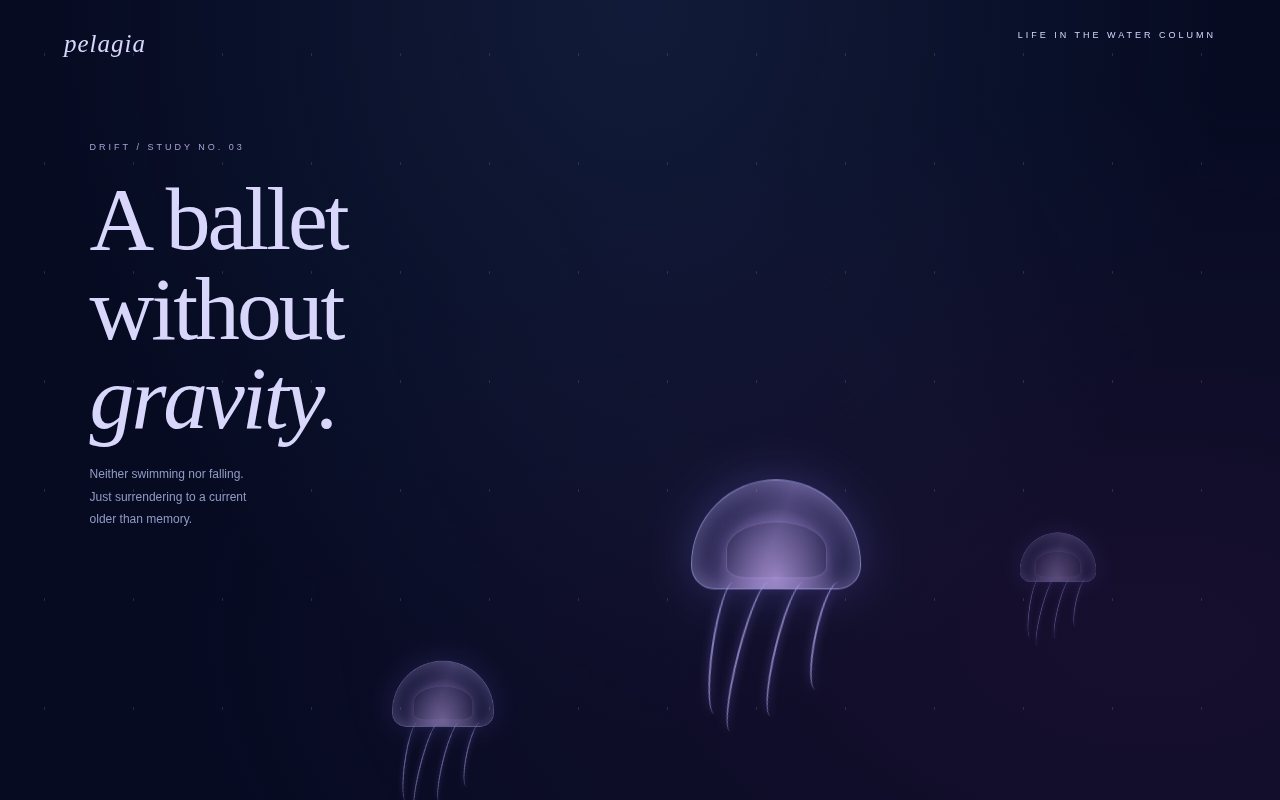
017 · Pelagia — A Ballet Without Gravity
Create an immersive CSS jellyfish artwork called Pelagia with midnight indigo, bioluminescent lavender and sparse suspended particles. Three differently scaled translucent jellyfish should drift at different phases, with domed bells, luminous inner organs and gently swaying tentacles. Place an elegant serif poem-like headline on the left and subtle controls beneath. Provide a bioluminescence hue shift and a pause/resume control. Responsive, offline, inline-only HTML and motion-safe CSS.
Note the last sentence. Five delivery constraints in eleven words, after the creative direction is already settled.
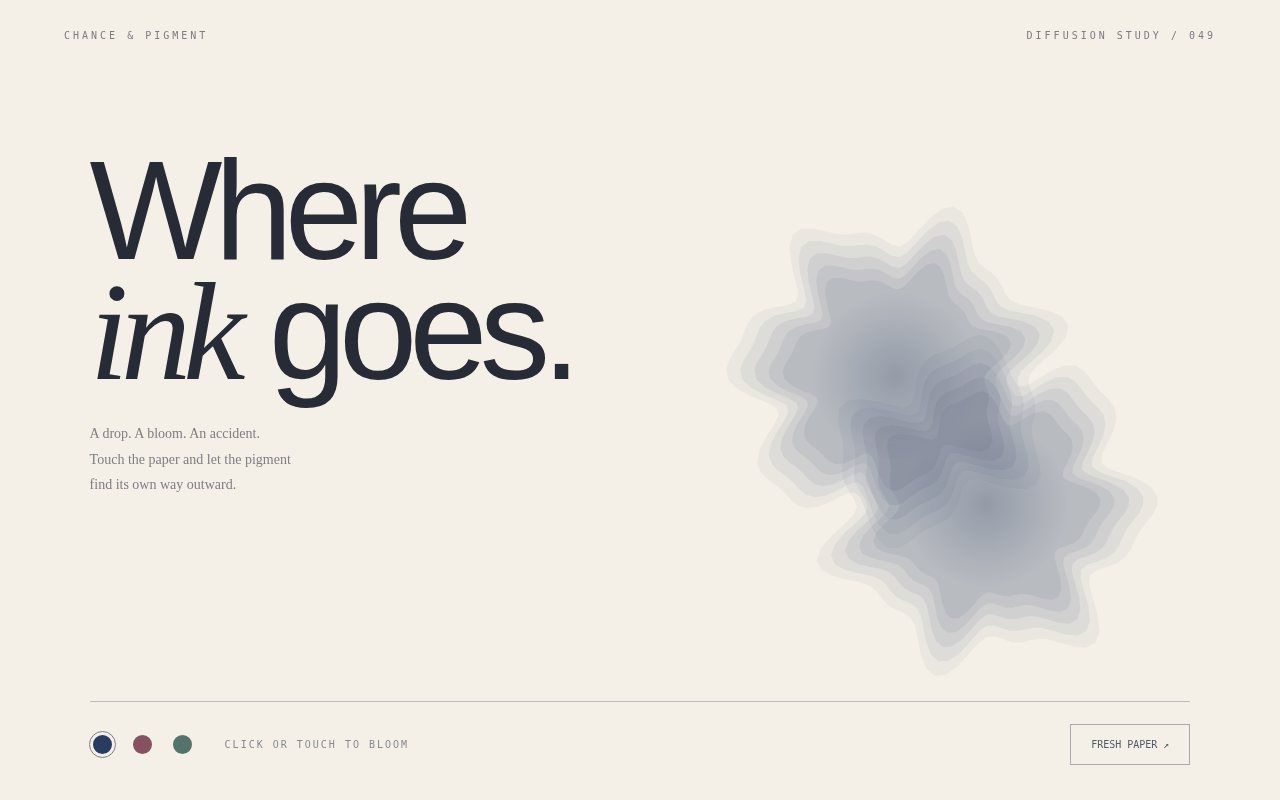
049 · Where Ink Goes
Create an interactive watercolor-ink art page in one offline HTML. Use warm ivory paper, large spare black modern and italic serif typography, and layered organic translucent pigment blooms on a full-screen canvas. Start with two elegant indigo blooms at right. Clicking or touching should add a bloom that expands into a wavy irregular edge. Provide indigo, rose and jade swatches with active states and a fresh-paper reset. Make the interface responsive and dependency-free.
"Start with two elegant indigo blooms at right" is the sentence to steal. It specifies the state the page opens in, not just what it can do — so the first frame is designed rather than empty.
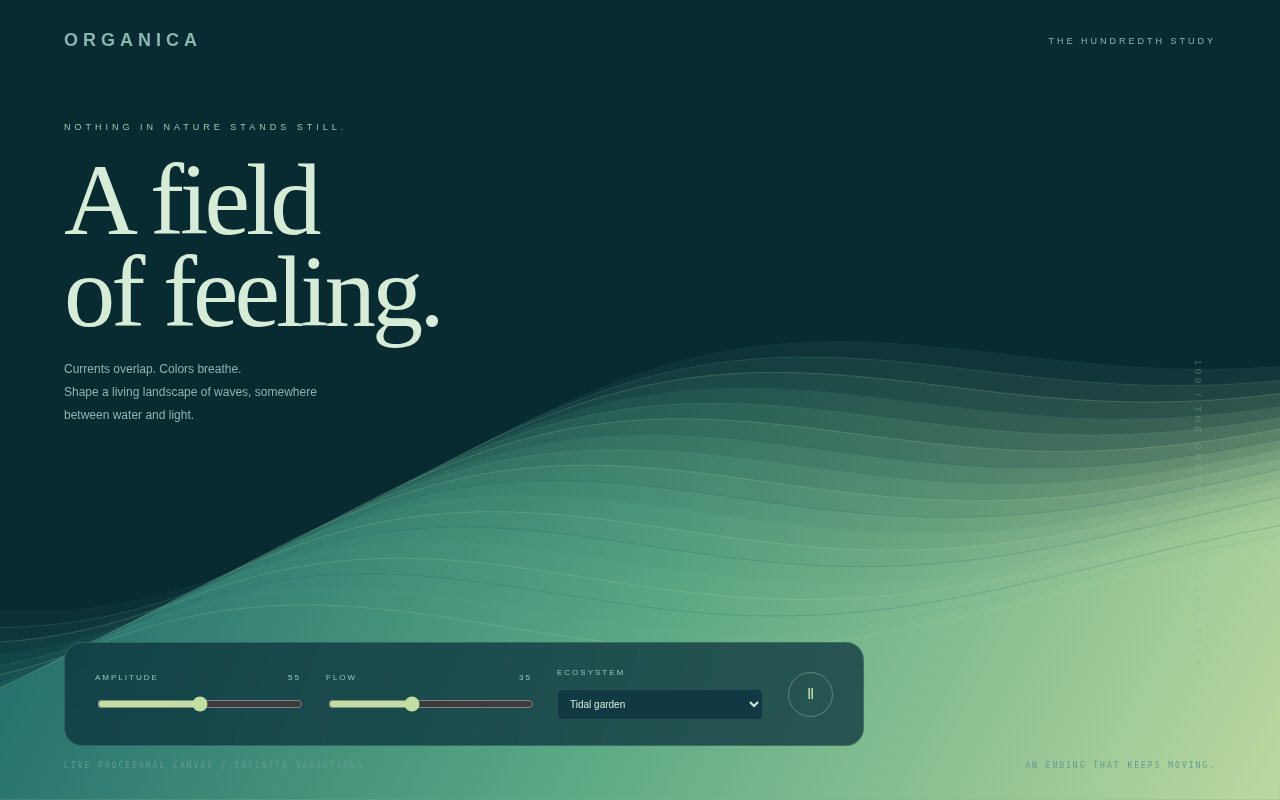
100 · Organica — Wave Laboratory
Create the collection’s closing artwork as an immersive organic wave laboratory. Fill a deep tidal-green viewport with eighteen translucent flowing canvas wave layers, blending teal, sage and luminous pale green. Overlay a large poetic serif headline at upper left and a frosted control dock near the bottom. Provide amplitude and flow-speed sliders, three ecosystem palettes and pause/play. Scale canvas for high-DPI and resize, respect reduced motion initially, and use only inline CSS/JavaScript in responsive offline HTML5.
Eighteen wave layers, not "several". Three palettes, not "a few". Counts appear throughout the hundred, and they are the difference between a brief and a wish.
The template, extracted
Across all 100 the same five slots appear in the same order:
- Imperative + what the thing is, named. ("an immersive organic wave laboratory")
- The visual world — palette, and above all the type treatment.
- The opening state — what is on screen before anyone touches it.
- The controls — named, countable, with their states.
- Delivery constraints — offline, responsive, inline-only, dependency-free.
Slot 3 is the one most people skip, and slot 5 is the one that decides whether the output is usable or a demo you cannot deploy.
Where the earlier claim held, and where it did not
The four principles drawn from a single game prompt were: a hard delivery constraint, a frozen core with an open surface, refusing to answer clarifying questions, and a stated judging criterion.
- Delivery constraint — confirmed. 74 offline, 88 responsive. This is the default, not a flourish.
- Frozen core, open surface — visible but not countable. The prompts fix palette, type and controls, then leave the rendering path open. I could not reduce that to a number without judging each prompt by hand, so I am not claiming one.
- No clarifying questions — not present. Zero of the 100 say it. That appears to be specific to one-shot game tests, not to this kind of work.
- Stated judging criterion — not present either. No prompt in the hundred tells the model how it will be scored.
Two of four generalised. The two that did not are the ones that came from a deliberate one-shot experiment rather than from ordinary use.
Limits
These are visual studies, not games — generative art, editorial layouts, physics toys, interfaces. The delivery constraints transfer; the typography weighting may not survive a move to a genre where nobody reads anything. And all 100 come from one author, so this measures one person's house style at scale, not the medium.
Prompt text quoted from the repository’s published .txt files; thumbnails from its thumbs/ directory. Counts computed over all 100 prompt fields on 2026-09-16.
← Back to all posts